A FIELD MANUAL FOR BOOTSTRAPPED FOUNDERS

The Founder’s Magic Glasses

What happens when a bootstrapped founder finally sees the business for what it is.

ANTHONY “KUMA” WASHINGTONFOUNDER & MANAGING DIRECTOR, NBLK® LLC

AN EQUITY BUILDER

Message from a Poet & Data Architect

Why I Built This

I was not supposed to be here.

For twenty years I kept my head down and built. Data systems. Applications. Databases. Websites. Policy work. Large things, for government and for nonprofits, the kind of systems that have to hold because people depend on what comes out the other side. Nobody claps for that work. There was the work, and there was me, and there was a belief I could not fully explain that one day it would be worth something to somebody besides me.

I am also a poet. Those two things are not separate. A data scientist has a poet’s soul, and a poet carries the eye of a scientist. Both are trying to take the noise of the world and make it mean something. And a poet learns early that you are supposed to speak truth to power.

What I kept seeing was this. Every tool my people used to run their businesses and their organizations had somebody else’s name on the bottom of it. Powered by. Built by. A product of. Always somebody else. Rarely us. Never a data and technology company that came from where we came from, built for us, owned by us.

That is what data is. It is not spreadsheets. It is power. It is knowing what is true about your own business before somebody else tells you what to think about it.

So I started NBLK.

Not as a company. As an ecosystem. A place to take twenty years of knowledge that I earned quietly, in rooms where nobody expected me, and hand it to my own people. To help small businesses and organizations own their tools, their code, their data, their systems. Not rent them. Own them. To stay in the Black, and to build something that outlasts the person who built it.

That was the intention. Intentions are not enough.

Because starting a business teaches you things you cannot be told. I had to learn them by doing, and some of them cost me. I learned that people can love you and still become misaligned with you. That everybody who says “we” does not always mean it. That generosity without structure creates conflict later, even between good people. That a handshake and somebody’s word is not enough — not because people are bad, but because memory changes when money shows up.

I had elders. I was fortunate that way. Men and women who saw further than I did and told me the truth when it was not comfortable. What they gave me was not business advice. It was sight.

Now I have two companies, with offices in the US and the UK.

But I have grown and I have scaled and I still want to bring my people with me. I stood on shoulders that were offered to me. I want to be that for my own.

These are some things I learned.

These are my magic glasses.

WHERE THE MAGIC GLASSES THEORY COMES FROM

The Magic Glasses
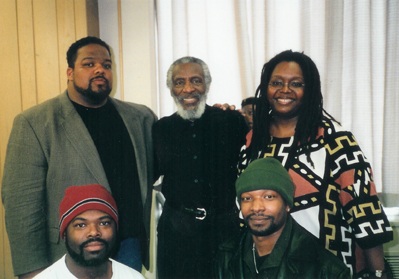
Anthony Washington with Dick Gregory and members of the Black Poets Collective
With Baba Dick Gregory and fellow members of the Black Poets Collective. Years ago I had the honor of working with Elder Gregory. I did not know then that I was being handed a pair of glasses I would not be able to take off.
Black Poets Collective

FOUNDED 1997

Baba Dick Gregory used the phrase to describe the perspective that comes from moving out of ethnocentrism and into world-centrism. Such an advance, he said, is like putting on special eyewear that lets you perceive what is invisible or absurd to those without them.

The magic glasses, Gregory warned, are both a blessing and a curse. The blessing is that eyesight through them is fuller and more evolved — more worthy of human beings. The curse is that those without the glasses will consider the wearer insane, or worse. And glassless folk cannot be talked into it. They come to it when their own growth allows them to, or they do not come to it at all.

What’s dangerous is when the universe picks you, and you put on the magic glasses. There’s rules that go with them. You can never take them off. You never see things as they’re supposed to be, you see things as they are. And you can never force nobody else to wear them.
DICK GREGORY, 1932–2017COMEDIAN · WRITER · ACTIVIST · SOCIAL CRITIC

My own experience confirms the insight. Our journeys, our lived experience, the critical distance we manage to get from our families and our cultures, and our encounters with great teachers can all raise the level at which we are able to see.

What follows is what the glasses showed me about building a company with no capital, no permission, and no safety net — and about the people who gather around a thing once it starts to look like it might work.

I

SECTION I · OPENING

You Saw Something Before There Was Something to See

There comes a point in the life of a founder when vision changes.

Not the vision in the pitch deck.Not the mission statement.Not the five-year plan.

I mean your actual vision.

The way you see people.The way you see loyalty.The way you see partnerships.The way you see money.The way you see ownership.The way you see advice.The way you see applause.The way you see who is building with you—and who is simply standing close enough to benefit if you win.

Especially when you are a bootstrapped founder.

Because when you bootstrap something, you know what it means to create value before anybody believes the value exists.

You remember when there was no company.

No revenue.No customers.No employees.No investors.No recognition.No headlines.No impressive title.No valuation.No audience waiting to applaud.
There was just an idea.And you.Maybe a laptop.Maybe a phone.Maybe a few dollars you could barely afford to lose.Maybe some savings.Maybe credit cards.

Maybe nights when everybody else was sleeping and you were trying to figure out how to make payroll, close a customer, fix a product, solve a technical problem, negotiate a contract, answer support emails, build a website, write a proposal, and somehow still convince yourself that this crazy thing could become real.

You saw something before there was something to see.

That is what makes founders different.

The world usually sees evidence.The founder has to see possibility.

And in the beginning, that vision is your greatest gift.

But if you survive long enough, another kind of vision begins to develop.

You start seeing people differently.You start seeing incentives differently.You start understanding that everybody standing beside the dream is not necessarily carrying the dream.
Everybody who says “we” does not necessarily mean “we.”Everybody who wants ownership does not want responsibility.Everybody who wants upside does not want sacrifice.Everybody who calls themselves a partner is not sharing the risk.Everybody giving advice does not have consequences attached to being wrong.Everybody who celebrates the company is not celebrating you.

Sometimes they are celebrating their proximity to what you created.

And that is when the founder receives what I call: The Founder’s Magic Glasses.

Those glasses come with three rules.

And once you put them on, building a company will never look the same again.

II

SECTION II · RULE NUMBER ONE

Once You Put the Glasses On, You Can Never Take Them Off

Once a founder truly sees how people behave around opportunity, ownership, money, influence, and success, it becomes almost impossible to go back to innocence.

In the beginning, founders often operate from belief. You believe people because you need to believe people.

You believe the person who says:

“I believe in your vision.”“I’m with you for the long haul.”“We’re building this together.”“Don’t worry about paperwork. We trust each other.”“When this thing takes off, we’ll all win.”“I don’t care about money.”“I just want to help.”“You can count on me.”
And maybe some of them mean it.At that moment.

But founders eventually learn something difficult:

Words are usually spoken in the present. Incentives reveal themselves in the future.

People can genuinely believe in you and still become misaligned with you.People can love you and still feel entitled to what you built.People can help you early and later rewrite history about the size of their contribution.People can give you advice and eventually believe their advice makes them responsible for your execution.People can make an introduction and later behave as though they created the company.People can work beside you without carrying anything close to the risk you carried.People can encourage you while the dream is uncertain—and become territorial once the dream becomes valuable.

That is when the glasses begin working.

You start separating:

support from sacrifice.access from ownership.advice from execution.presence from contribution.loyalty from dependency.friendship from business alignment.enthusiasm from commitment.association from creation.

And once you learn those distinctions, you cannot unknow them.

You start remembering who was there when there was nothing. Not just who was physically around.

Who actually carried weight?Who solved problems?Who took risk?Who worked when nobody was watching?Who stayed when there was no obvious reward?Who put skin in the game?Who created measurable value?Who accepted accountability?Who sacrificed something real?

And equally important: Who only became deeply interested once there was something to divide?

That realization changes a founder. Because success creates gravity. And gravity attracts people.

Some people are attracted to the mission.Some to the money.Some to the access.Some to the title.Some to the status.Some to the network.Some to the possibility of equity.Some to the founder personally.Some to what they believe the founder may eventually become.

And some people do not consciously know why they are attaching themselves. But the founder has to know.

Because eventually attachment becomes expectation.Expectation becomes entitlement.Entitlement becomes conflict.

And conflict becomes:

“You couldn’t have done this without me.”“I deserve more.”“I thought we were partners.”“You changed.”“You forgot who helped you.”“That isn’t fair.”“We built this.”

And sometimes those statements are legitimate. Sometimes somebody truly did build alongside you and deserves recognition, compensation, authority, or ownership.

The glasses are not supposed to make you paranoid. They are supposed to make you precise.

Because there is another dangerous mistake founders make: seeing exploitation everywhere. That is not wisdom either.

The purpose of the glasses is not to distrust everybody. The purpose is to see accurately.

Give credit where credit is earned.Give ownership where ownership is justified.Give compensation where value is created.Honor sacrifice where sacrifice occurred.
But do not confuse emotional closeness with economic contribution.Do not confuse longevity with value creation.Do not confuse friendship with fiduciary responsibility.Do not confuse encouragement with ownership.

And do not give permanent pieces of your company because of temporary emotions.

Once you see that clearly, you cannot take the glasses off.

III

SECTION III · RULE NUMBER TWO

You Can Never Again See the Business the Way Other People Tell You to See It

This may be the hardest transformation for a founder. Because everybody has an opinion about your company.

Employees.Advisors.Friends.Family.Investors.Potential investors.Consultants.Lawyers.Customers.Partners.Competitors.People who have never built anything.People who built something twenty years ago.People who failed.People who succeeded.People who want something from you.

Everybody will tell you what your company is.

“You need to raise money.”“You’re crazy not to sell.”“You should give this person equity.”“You need a cofounder.”“You need to hire faster.”“You’re moving too fast.”“You’re moving too slowly.”“You should bring in professional management.”“You should step aside.”“You need to think bigger.”“You need to be realistic.”“You owe them.”“They were there early.”“You can trust them.”“You can’t trust them.”

But once you have the glasses, you stop accepting narratives without examining incentives.

You start asking:

Who benefits if I believe this?

That question will save founders years of pain.

Someone tells you that you desperately need capital.Maybe you do.But ask: Who benefits from the financing?
Someone tells you that you need to give away equity.Maybe that person deserves equity.But ask: What permanent value are they providing in exchange for permanent ownership?
Someone tells you that a deal must happen immediately.Ask: Why the urgency?

Someone tells you they should become your partner. Ask:

What risk are they assuming?What capital are they contributing?What capabilities are they bringing?What measurable outcomes are they responsible for?What happens if they fail?

Someone wants 10% of your company. The founder’s glasses ask: Ten percent in exchange for what?

Not emotionally.Mathematically.Economically.Strategically.Legally.

If the company someday becomes worth $100 million, that 10% represents $10 million before dilution and other complexities. What exactly was exchanged for that economic claim?

An introduction?Six months of advice?A relationship?A promise?A few meetings?A title?

Or years of indispensable execution, risk, sacrifice, capital, intellectual property, customers, leadership, and measurable enterprise value?

Those are very different things.

Founders without the glasses often negotiate ownership based on the present.

Founders with the glasses understand that equity is a claim on the future.

That is why equity should never be treated casually. Because founders often give equity when they have no cash. It feels cheap.

But equity is often the most expensive currency a founder will ever spend.

A consultant might cost $20,000.Equity that feels worth $20,000 today could someday be worth $2 million.Or $20 million.Or nothing.Nobody knows.

That uncertainty is exactly why founders must understand what they are exchanging.

The glasses force you to distinguish between what feels fair today and what remains fair if the company succeeds beyond everyone’s expectations.

That changes everything.

IV

SECTION IV · LANGUAGE

The Glasses Also Change How You See “We”

“We” is one of the most dangerous words in startup culture.

“We built this.” Sometimes that statement is completely true. Great companies are rarely built by one human being alone.

Employees build.Executives build.Engineers build.Salespeople build.Operators build.Customers contribute.Partners contribute.Families sacrifice.Mentors help.Investors provide resources.

Nobody serious should deny the contributions of others.

But contribution does not automatically mean equal authorship. And participation does not automatically mean equal ownership.

There is a difference between helping build the house and owning the land, designing the house, financing the construction, carrying the mortgage, signing the guarantees, and being responsible if the entire thing collapses.

Both contributions can matter. They are simply not identical.

A founder wearing the glasses learns to ask:

Who conceived the original vision?Who took the first risk?Who provided the initial capital?Who worked unpaid?Who signed the guarantees?Who carried the legal liability?Who recruited the team?Who closed the first customers?Who created the intellectual property?Who survived the periods when the company almost died?Who had the responsibility when everybody else could walk away?

Because there is a profound difference between being involved in the upside and being responsible for the downside.

When the company wins, many people can say: “We did it.”

When the company is thirty days from running out of money, the founder discovers what “we” really means.

Who signs the check?Who finds the money?Who calls the customer?Who gets sued?Who guarantees the lease?Who loses the savings?Who has their reputation attached to the failure?Who cannot simply update LinkedIn and move on?

That is where ownership becomes real.

V

SECTION V · RULE NUMBER THREE

You Cannot Force Other People to See What You See

This is the most painful rule. Because once founders develop pattern recognition, they want to protect everybody.

You see a bad partnership forming.You warn someone.They do it anyway.
You see someone being manipulated.You explain it.They defend the manipulator.

You see an employee who is clearly misaligned. Others tell you: “They’re a great person.” Maybe they are. But being a great person and being right for a particular company are two different questions.

You see a deal where the incentives are wrong. Everybody else sees money.

You see control.You see dilution.You see dependency.You see future leverage.You see the second-order consequences.

And you try to explain it. But they cannot see it.

That does not necessarily mean they are unintelligent. They simply may not have lived what you have lived.

Founders develop vision through scars.

A contract that almost destroyed the company teaches you something.A partnership that went bad teaches you something.An employee who manipulated internal politics teaches you something.A customer who represented too much revenue teaches you something.An investor negotiation teaches you something.A person who claimed loyalty until money appeared teaches you something.

You cannot transfer ten years of scars in a ten-minute conversation.

That is why you cannot force awareness.

You can explain.You can document.You can warn.You can teach.You can create systems.You can establish boundaries.

But eventually people must see for themselves. And sometimes they never will.

The founder’s responsibility is not to make everybody see. The founder’s responsibility is to make decisions based on what the founder can see.

VI

SECTION VI · THE HARDEST THING THE GLASSES REVEAL

Some People Love the Founder. Some People Love the Opportunity Around the Founder.

Those two things can look almost identical. Especially early.

Someone calls constantly.Supports you.Introduces you around.Shows up.Talks about the vision.Tells everyone how brilliant the company is.

You think: “This person believes in me.” Maybe.

But watch what happens when boundaries appear. Watch what happens when you say:

“No equity.”“No title.”“No commission.”“No access.”“No board seat.”“No special treatment.”“No, you cannot use my relationships.”“No, you cannot represent yourself as a founder.”“No, you cannot make decisions on behalf of the company.”“No.”

That is when relationships reveal themselves.

Because genuine support can survive boundaries. Extraction usually cannot.

One of the founder’s greatest tests is learning to recognize people who are attached to you versus people attached to what flows through you.

Access.Money.Opportunity.Status.Network.Information.Deals.Influence.Potential future wealth.

When the benefits disappear, watch who remains.

That does not mean every relationship must be tested cynically. It means founders must understand incentives.

A person can care about you and still have incentives. Those truths can coexist. The glasses allow you to see both.

VII

SECTION VII · SELF-EXAMINATION

The Founder Also Has to Turn the Glasses on Themselves

This is where real maturity begins. Because the magic glasses cannot only expose everybody else. They must expose you.

Maybe you kept the wrong person too long because you were afraid of confrontation.Maybe you gave equity because you wanted approval.Maybe you called someone a partner because you were lonely.Maybe you ignored contracts because paperwork felt uncomfortable.Maybe you let friendship substitute for governance.Maybe you allowed ambiguity because clarity might upset somebody.Maybe you overpromised.Maybe you failed to communicate expectations.Maybe you benefited from somebody’s work without compensating them fairly.Maybe you changed the deal after the company became valuable.Maybe someone genuinely contributed more than you want to admit.Maybe your ego makes you believe every success belongs to you.Maybe your fear makes you believe everyone wants to take something from you.

Both can be dangerous.

A founder who sees everybody else clearly but cannot see themselves clearly is still blind.

The glasses must work both ways.

They should reveal exploitation. But they should also reveal ego.They should reveal entitlement. Including your own.They should reveal manipulation. Including when you are the one using emotional leverage.They should reveal unfairness. Even when acknowledging that unfairness costs you something.

Because founder protection is not the same thing as founder worship.

A founder deserves protection.The company deserves protection.Employees deserve fairness.Partners deserve clarity.Shareholders deserve responsible governance.Customers deserve integrity.

The goal is not: Founder wins. Everybody else loses.

The goal is: Everybody understands the deal. Everybody knows what they are responsible for. Everybody receives what was legitimately agreed upon and earned. Nobody gets to rewrite history because the company became valuable.

That is what the glasses should produce: Clarity.

VIII

SECTION VIII · EQUITY

The Glasses Change How You See Equity

Before the glasses: “Give them some equity. They helped us.”

After the glasses:

What specifically did they contribute?For how long?At what level of risk?Was the contribution replaceable?Was it measurable?Was it already compensated?Was the equity vested?Were milestones attached?What happens if they leave?What happens if they stop contributing?What happens if they compete?What intellectual property belongs to the company?What decisions come with that ownership?What voting rights exist?What happens during acquisition?What happens during financing?What happens if the relationship deteriorates?

Founders eventually learn:

Generosity without structure creates future conflict.

You can be generous. But document the generosity.You can reward people. But define the reward.You can share ownership. But structure ownership.You can create partnerships. But define the partnership.You can trust people. But still sign agreements.

Contracts are not the opposite of trust.

Good contracts preserve relationships by making expectations explicit before memories and incentives change.

Because people remember contributions differently once money appears.

When there is nothing: “Nobody cares.”When there is something: “Everybody remembers helping.”When there is a lot: “Everybody remembers helping more than they actually did.”

That is human nature. Documentation protects everybody.

IX

SECTION IX · LOYALTY

The Glasses Change How You See Loyalty

Founders often overvalue loyalty. They say: “They’ve been with me since the beginning.”

That matters. But longevity alone is not performance.

A person can be loyal and still no longer be right for the role.A person can have been essential at $500,000 in revenue and become a bottleneck at $10 million.Someone can be brilliant in chaos and ineffective in scale.Someone can help build version one and not be capable of leading version ten.

That does not erase their contribution. It simply means companies evolve.

The founder’s responsibility is to honor the past without sacrificing the future.

You can say: “You helped us get here.”And simultaneously say: “You are not the person who can take us there.”

Those statements can both be true.

Gratitude does not require permanent organizational dependency.

You can appreciate someone without giving them permanent authority.You can love someone without making them your business partner.You can honor someone without giving them equity.You can reward someone without giving them control.You can remember who helped you without allowing that history to become a lifetime claim against the company.
X

SECTION X · MONEY

The Glasses Change How You See Money

Money does not always change people. Sometimes money reveals them.

When there is no money, hypothetical generosity is easy.

“We’ll all eat.”“We’ll take care of everybody.”“We’re family.”

Then the company becomes valuable.

Suddenly percentages matter.Titles matter.Ownership matter.Control matters.Exit proceeds matter.

And people begin doing mathematics. That is when vague relationships become dangerous.

Ambiguity survives poverty better than prosperity.

When there is nothing to divide, nobody argues about division.

Success tests relationships differently than failure.Failure asks: “Will you stay?”Success asks: “What do you believe you deserve?”

Those are two completely different tests.

The glasses teach founders to have difficult conversations before the money arrives.

Who owns what?Who earns what?Who controls what?What happens if someone leaves?What happens if somebody stops performing?What happens if the company raises capital?What happens if the company sells?What happens if the founders disagree?What happens if somebody dies?What happens if somebody becomes disabled?What happens if someone gets divorced?What happens if someone wants liquidity?What happens if somebody competes?What happens if somebody believes they deserve more?

The best time to answer those questions is when everybody still likes each other.

XI

SECTION XI · ADVICE

The Glasses Change How You See Advice

Founders receive endless advice. But advice is cheap because the person giving it usually does not absorb the full consequences.

“Hire fifty people.” If that fails, who makes payroll?“Raise $20 million.” If that dilutes your control, who lives with it?“Give them 5%.” If that stake becomes worth millions, who gave away the ownership?“Take the deal.” If the partnership becomes toxic, who lives inside the contract?“Fire them.” If the company loses critical knowledge, who repairs the damage?

The glasses teach a founder:

Listen to advice. But trace the consequences. Never outsource judgment.

Experts can provide information.Lawyers can explain legal risk.Accountants can explain financial implications.Investors can explain markets.Operators can explain execution.Mentors can share experience.

But the founder must integrate all of it. Because the founder lives at the intersection of every consequence.

XII

SECTION XII · VISION

The Glasses Change How You See Your Own Vision

This is perhaps the most important part.

At first, people will tell you the dream is impossible. Then if you start succeeding, some of those same people will tell you they always believed.

That is normal. Human beings understand things better after evidence appears.

Do not waste your life trying to correct everybody’s historical memory.

You know what happened.Keep records.Honor the truth.Then keep building.

Because the greatest danger after putting on the glasses is bitterness.

A founder can become so focused on:

Who doubted me.Who used me.Who betrayed me.Who wanted equity.Who took credit.Who disappeared.Who came back.

That the founder stops building.

Then the glasses become a prison.

The purpose of seeing clearly is not to spend your life staring at betrayal. The purpose is to make better decisions.

See it.Learn from it.Structure around it.Then move.
Do not spend ten years proving somebody was fake. Build something real.Do not spend ten years explaining who deserves what. Document it. Govern it. Execute.Do not spend ten years trying to make people understand your vision. Build enough evidence that the vision speaks for itself.
XIII

SECTION XIII · SUMMATION

The Founder’s Three Rules

So if I had to translate the magic glasses into the language of a bootstrapped founder, I would say this:

RULE ONE

Once You See Incentives, You Can Never Go Back to Only Hearing Words.

You will still listen to what people say. But you will watch what they risk.

What they contribute.What they sacrifice.What they demand.What they do when nobody is watching.What happens when you say no.What happens when money appears.What happens when money disappears.What happens when there is credit to claim.What happens when there is blame to absorb.

That is where truth lives.

RULE TWO

Once You Know Your Company, You Cannot Let Other People Define Its Value, Its Story, or Your Obligations for You.

Listen.Learn.Stay humble.Correct yourself when you are wrong.

But do not surrender your judgment simply because somebody speaks confidently.

You were there.You know what was risked.You know who built what.You know what was promised.You know what was sacrificed.You know what was documented.You know what the company survived.
Protect the truth.Not your ego.The truth.
RULE THREE

You Cannot Force People to See the Vision, the Risk, or the Truth the Way You See It.

Some people will only understand after the company succeeds.Some will never understand.Some will believe you got lucky.Some will believe they deserve more credit.Some will think you became selfish when you established boundaries.Some will say you changed.

Maybe you did. Growth should change you.

The question is whether you became clearer or colder.Stronger or bitter.More disciplined or more paranoid.

The glasses should make you wiser. Not cruel.

You do not need everybody to understand. You need the right people aligned around clear agreements, shared expectations, measurable contribution, mutual respect, and a mission worth pursuing.

XIV

SECTION XIV · THE FOURTH RULE

And There Is a Fourth Rule for Founders

The original lesson may stop at three. But entrepreneurship adds another.

RULE FOUR

Never Let What You Discover About People Destroy What You Discovered About Yourself.

You discovered that you could build.You discovered that you could survive uncertainty.You discovered that an idea in your head could become something customers would pay for.You discovered that you could create jobs.Solve problems.Generate value.Lead.Adapt.Endure.
Do not allow betrayal to turn vision into suspicion.Do not allow entitlement to turn generosity into selfishness.Do not allow manipulation to make you incapable of trusting good people.Do not allow one bad partner to make you reject partnership.Do not allow one dishonest employee to make you treat every employee like a thief.Do not allow one predatory investor to make you believe all capital is evil.Do not allow success to convince you that you did everything alone.And do not allow gratitude to convince you that everybody who helped deserves ownership of what you built.

Hold both truths.

Nobody builds anything meaningful entirely alone. And not everybody who helped build something owns the thing that was built.

Wisdom is knowing the difference.

XV

SECTION XV · CODA

The Final Lesson

The Founder’s Magic Glasses are both a blessing and a burden.

Because once you see the difference between loyalty and leverage, you cannot unsee it.Once you understand incentives, you cannot unknow them.Once you understand the true cost of equity, you cannot casually give it away.Once you understand that access creates entitlement in some people, you become more careful about access.Once you understand that people remember history differently when money appears, you start documenting history.Once you understand that relationships change as companies grow, you stop relying solely on relationships and start building governance.Once you understand that somebody can love you and still be economically misaligned with you, you stop turning every business disagreement into a moral judgment.Once you understand that someone can disagree with you without betraying you, you become a better leader.And once you understand that some people really are trying to attach themselves to your dream for their own gain, you stop apologizing for protecting what you built.

That is the balance.

Do not become paranoid. Become precise.Do not become cold. Become clear.Do not stop trusting. Trust intelligently.Do not stop being generous. Structure your generosity.Do not stop listening. Evaluate the incentives behind the advice.Do not give everybody equity because they helped.Do not deny everybody equity because you are afraid.

Give people what they genuinely earn and what you consciously agree to.

Do not confuse a handshake with governance.Do not confuse friendship with alignment.Do not confuse proximity with contribution.Do not confuse contribution with ownership.Do not confuse ownership with control.

And never confuse somebody wanting your dream to succeed with somebody being willing to carry the weight required to make it succeed.

Because a founder sees the dream before the world sees the company.The founder sees the building while everybody else sees an empty lot.The founder sees customers before the first sale.The founder sees an organization before the first employee.The founder sees possibility where everybody else sees risk.

But eventually, if you survive long enough, the universe hands you another kind of vision. You begin seeing the people around the dream.

Not as villains.Not as heroes.But clearly.
You see who contributes.You see who consumes.You see who creates.You see who extracts.You see who takes risk.You see who only wants upside.You see who tells you the truth.You see who tells you what keeps them close to opportunity.You see who respects boundaries.You see who disappears when boundaries appear.You see who wants to build something.And you see who simply wants a piece of something being built.

Once those glasses go on, you cannot take them off. And maybe you should not.

Because the founder’s job is not merely to dream. The founder’s job is to protect the conditions that allow the dream to survive.

Protect the mission.Protect the company.Protect the cap table.Protect the culture.Protect the cash.Protect the intellectual property.Protect the relationships worth protecting.Protect the people genuinely building beside you.Protect yourself from your own ego and blind spots.

And above everything: Protect the truth.

Because everybody may eventually have their own version of how the company was built. But the founder must never forget what actually happened when there was nothing.

Before the valuation.Before the attention.Before the titles.Before everybody started saying “we.”

There was a moment when the company existed nowhere in the world except inside your mind.

You saw it.You believed it.You risked something for it.Then you started building.

That was the first vision. The magic glasses give you the second: the ability to see clearly what happens when the rest of the world finally begins to see value in what you saw first.

That second vision may be less beautiful. But it may be the vision that protects the first.

So wear the glasses.Keep your heart.Keep your humility.Keep your receipts.Keep your agreements clear.Keep your cap table intentional.Keep your boundaries.
Give credit where credit is due.Give ownership where ownership is earned and agreed.Never rewrite history to make yourself bigger.And never allow somebody else to rewrite history to make your contribution smaller.
You do not have to force anyone to see what you see.You do not have to convince everybody.You do not have to expose everybody.You do not have to fight every person who misunderstands you.

Sometimes the most powerful thing a founder can do is simply see clearly — and govern accordingly.

Because once the founder has the magic glasses, the question is no longer: “Can you see?”

The question becomes: “Now that you can see, what are you going to build — and what are you going to protect?”